Advancing digital twins — real-world impact in patient care and consumer insights
A digital twin is only as useful as the decision it is allowed to touch. That is the line I keep coming back to. The interesting work on these prototypes was never the model architecture — it was earning the right for a simulated trajectory to sit in a room where a protocol or a product decision is being made.
I have been building two twins in parallel, in domains that look nothing alike. One simulates Type 2 diabetes patients so a trial team can pressure-test a protocol before enrolling a single person. The other models how consumers actually live with nutraceuticals — protein, vitamins, the whole supplement aisle — day by day, week by week. Different stakeholders, different data, different consequences. Same backbone, same discipline about what the twin is allowed to claim.
Regulators are converging on the same discipline. The EMA has issued a qualification opinion for Unlearn's PROCOVA digital-twin methodology as a primary analysis in phase 2/3 trials with continuous outcomes[1], and the FDA's January 2025 draft guidance[2] formalises a seven-step credibility framework keyed to the context of use — what the model is for, not what the model is. Both prototypes were built with that bar in mind.
1. Patient digital twin — simulating Type 2 diabetes journeys
The use case is narrow on purpose: simulate patient trajectories well enough that a trial team can stress-test dose schedules and inclusion criteria before committing to a protocol. Narrow-and-validated beats broad-and-suggestive every time when the output has to withstand a statistical review.
The engine is a conditional variational autoencoder[3], conditioned on demographics, baseline labs, trial parameters, and features distilled from the biomedical literature. Adjacent work pointed the way: a generative deep-learning simulator for Type 1 diabetes[4] showed what good looks like for glycaemic trajectories, and HbA1c trajectory clustering across 60,423 patients[5] surfaced the cluster structure the twin has to reproduce — stable, descending, and ascending trends — rather than collapse into a single average curve.
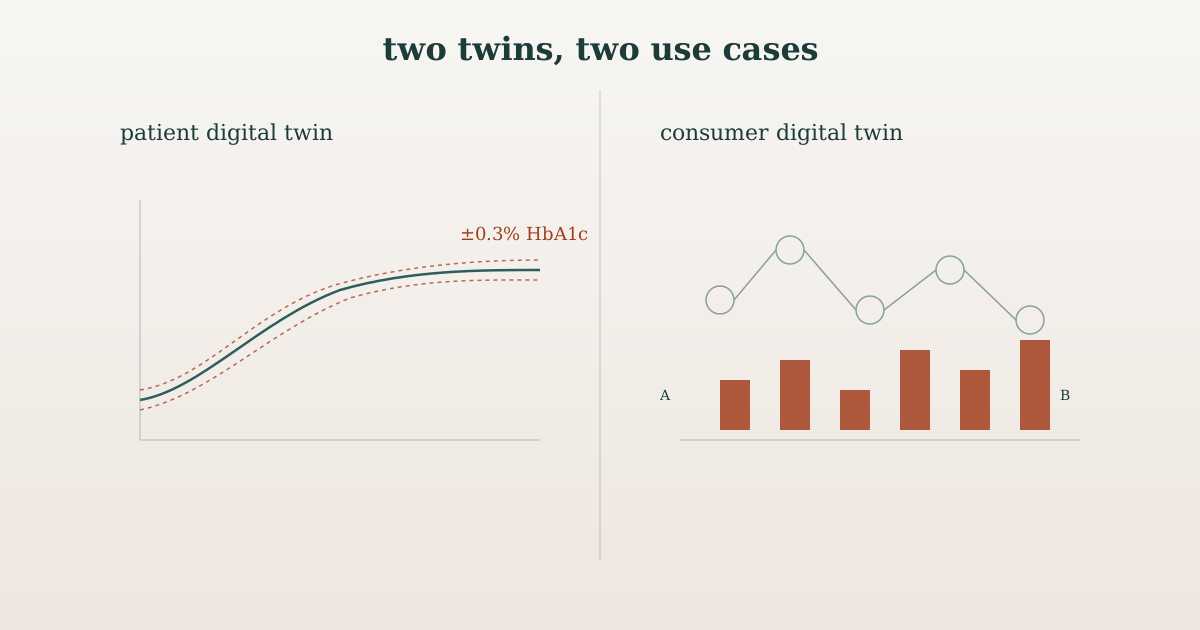
The headline number that matters: synthetic HbA1c trajectories track real-world curves within ±0.3% over 56 weeks. That is inside the noise floor of most T2D trial endpoints, which is the bar for letting this output influence a go/no-go on protocol design.
In practice, that looks like this:
- Propose an inclusion criterion. See how the HbA1c distribution shifts across the simulated cohort.
- Move a dose titration schedule by two weeks. See the 26-week endpoint move with it.
- Tighten the upper age bound. See which cluster of trajectories disappears, and whether the ones that remain still power the trial.
Every one of those questions used to require a protocol amendment to answer with any confidence. Now it is a simulation run before the amendment is written.
2. Consumer digital twin — modelling nutraceutical adherence
Different problem, different data: reviews, click-streams, wearables, purchase cadence, support transcripts. Same discipline. A consumer twin earns its place when a brand team can ask "what happens to adherence in weeks 4–8 if we move from a 30-day pack to a 90-day pack" and get an answer they are willing to act on.
The stack, honestly described:
- LLMs as structured ETL. Reviews and support transcripts get embedded and normalised into a consistent persona schema. The LLM is not writing anything end-user-facing — it is doing the boring, high-leverage work of turning heterogeneous text into features the downstream model can consume. It also fills in edge-case personas (weekend-skippers, bulk-buyers who taper by month three) that are real but sparse in any single dataset.
- CVAE framework for day-by-day behaviour. Same backbone as the patient twin, conditioned on purchase cadence, wearable signals, and persona features. Output is a daily adherence trajectory per persona — not a single mean.
- Agent-based simulation on top.[6] Because "how does a cohort respond to a 20%-off coupon in week 3" is not the same question as "how does the average user respond." ABM is where cohort-level interaction effects show up — bundle cannibalisation, social-proof flywheels, promotions that lift trial but tank retention.
What the tech stack actually does
A few pieces are worth naming because they are where the work is, not where the headlines are.
LLMs as infrastructure, not product. The high-value LLM work here is embedding, normalisation, and plausible synthesis of undersampled edge cases. Treating the LLM as an ETL component — boring, composable, replaceable — is what makes the rest of the system trustworthy. Treating it as a generator-of-answers is what blows it up.
Controllable CVAEs. The conditioning variables are exposed as knobs. "Simulate a 20% increase in missed doses." "Shift the age distribution five years older." The downstream trajectories update in real time, and the output is interrogable by non-modellers — a trial lead or a brand manager can interact with the simulation in their own vocabulary, not in PyTorch.
Graph DBs for persona queries. "Show me users who skip lunch and under-dose by 20% in weeks 4–8." In SQL that question is painful. In a graph query it is two lines. Asking better questions is usually rate-limited by how painful it is to express them.
What still needs to be true
The honesty clauses, because a twin that overclaims is worse than no twin:
- Reinforcement learning for packaging optimisation is on the roadmap, not in the current build. It is the natural next step once the CVAE + ABM layer is stable.
- Physiology add-ons — linking HbA1c to kidney function, for instance — matter the moment the twin is asked a question beyond the endpoint it was trained on. Every extension needs its own validation against real curves.
- Cohort-mapping guardrails. Synthetic data is only as trustworthy as the real cohort it claims to represent. The twin has to refuse to answer for populations it was not trained on, and the UI has to make that refusal legible rather than hide it behind a plausible-looking output.
Both prototypes lean on open-source CVAE and LLM tooling — this is an independent exploration, not a productised system. The point was never to ship a twin. It was to work through, in a setting where I owned every choice, what it takes for a synthetic trajectory to earn the right to be in the room when a decision is made. The answer keeps being the same: conditioning that reflects domain structure, validation against real curves at the level of the endpoint that matters, and the discipline to let the twin say "I do not know" the moment the question drifts outside its training distribution.
Everything else is window dressing.
References
- 1.Unlearn.AI — PROCOVA / TwinRCTs methodology, qualified by the EMA for phase 2/3 trials with continuous outcomes.
- 2.U.S. FDA (January 2025). Considerations for the Use of Artificial Intelligence to Support Regulatory Decision-Making for Drug and Biological Products — draft guidance, including the seven-step credibility framework.
- 3.Physiology-Informed Conditional Variational Autoencoder for Generating Pediatric Virtual Patients. medRxiv, 2026.
- 4.Generative deep learning for the development of a type 1 diabetes simulator. Communications Medicine, 2024.
- 5.Patient clusters based on HbA1c trajectories: a step toward individualised medicine in type 2 diabetes. PLOS One, 2018.
- 6.Agent-based modelling — the simulation approach used for cohort-level responses to interventions.