Three places patient digital twins mislead
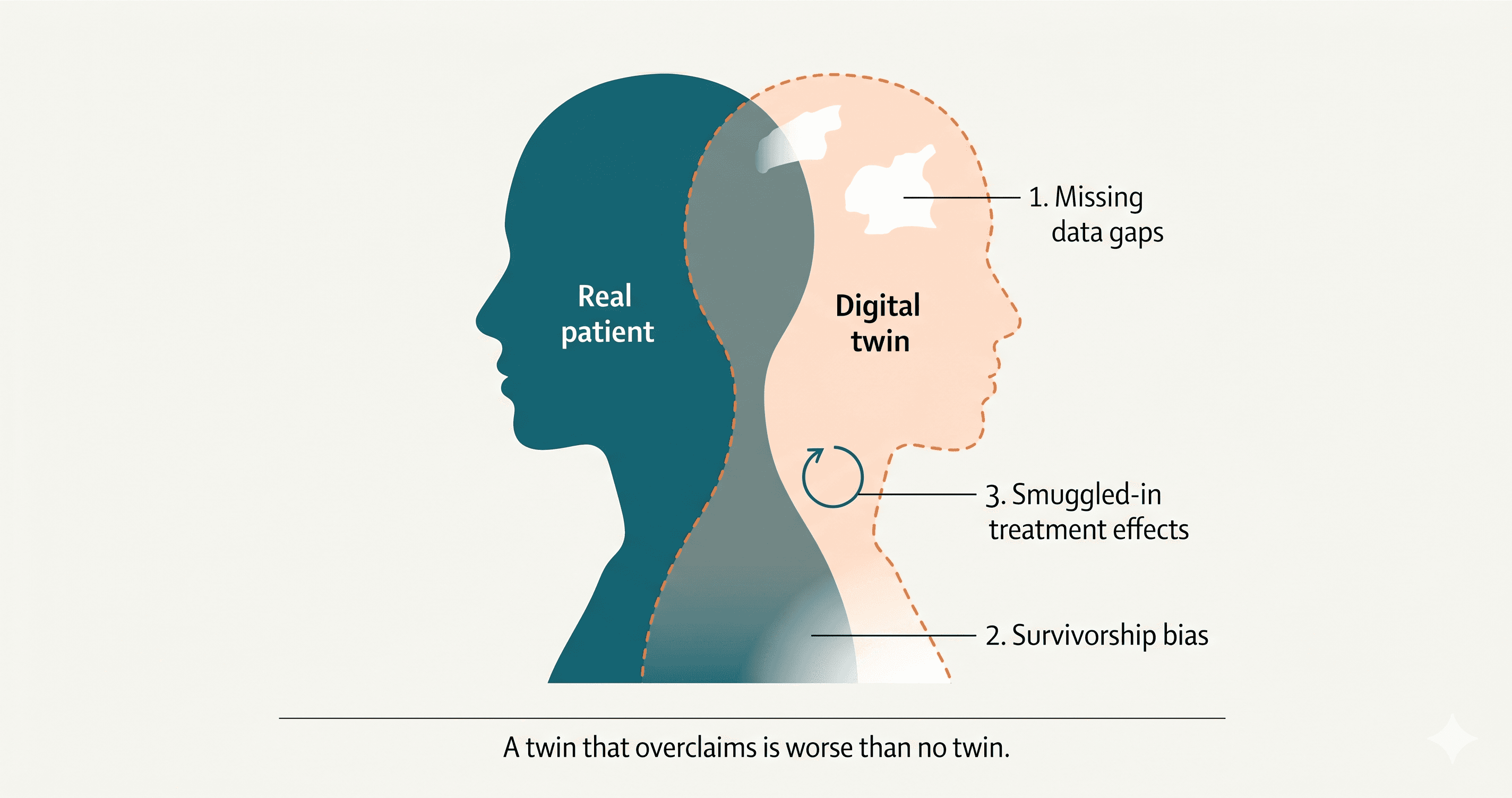
Patient digital twins are genuinely useful. They compress a messy medical history into something a model can reason over, they let you simulate counterfactuals, and they occasionally surface subgroups a trial was never powered to find. Used well, they shorten decisions. Used poorly, they shorten them in the wrong direction.
They also fail — and they tend to fail with a straight face. Three patterns I keep running into, each of which has a design implication that most teams skip.
1. The twin looks nothing like the patient it is modelling
A twin built from registry data, claims, and a handful of lab values can look plausible on a dashboard and bear no resemblance to the person sitting in front of a clinician. Medication adherence is missing. Social determinants are missing. The last six months of deterioration are missing because the data lags by a quarter. Any recommendation derived from this twin is a recommendation for a fictional patient who happens to share a zip code with the real one.
The fix is not more features — features will always be missing. The fix is being honest in the UI about what the twin is not modelling, so the clinician can weight its output accordingly. A twin that displays a confidence band without naming the blind spots is worse than no twin at all, because it replaces "I do not know" with "the model said so."
2. Distributional twins trained on who made it into the dataset
If your twin population is built from patients who reached a tertiary care centre and consented to research, your model has learned the physiology of a specific survivorship-biased cohort[1]. Generalising to primary care, to under-represented populations, or to the patients who never made it into the registry at all is not a validation question — it is a first-principles problem that more validation data will not fix.
This is now a first-class concern in the digital twin literature[2]: because twins are often built from trial-participant data, they inherit the generalisability limits of the trials they were trained on. A twin that looks accurate on in-distribution patients and is silent about where the distribution ends is a twin that will be used confidently in the exact places it should not be.
The design implication: the twin has to refuse to answer for populations it was not trained on, and the refusal has to be visible. "No prediction available for this cohort" is a feature, not a bug report.
3. Counterfactuals that smuggle in the treatment effect you were trying to measure
The most seductive failure. You build a twin, you ask "what if we had given drug B instead of drug A," and the twin produces a confident number. But the features driving the prediction — prescriber network, disease severity at prescription, insurance tier — are themselves correlated with whoever historically received A versus B. The twin has silently encoded the old treatment allocation policy. Your counterfactual is a restatement of clinical practice in 2019, not a prediction about 2026.
Regulators have seen this one. The EMA's qualification of Unlearn's PROCOVA[3] is narrow on purpose — it treats the digital twin as a prognostic covariate in an RCT, not as a synthetic control arm that would let you skip the randomisation. The distinction matters. A twin that augments a properly randomised comparison is adding information. A twin that replaces randomisation is often confidently reproducing the bias it was supposed to help you see through.
What actually earns a clinician's trust
The pattern across all three: the twins clinicians use are the ones that acknowledge their own boundaries — in the data they trained on, in the populations they represent, in the counterfactuals they are licensed to simulate. Everything else gets politely ignored, which is the best-case outcome. The worse case is that it gets used, confidently, in the situation where it was always going to be wrong.
Digital twins are not going away. The question is whether they ship with the honesty architecture that lets them be useful — or whether they ship as confidence machines whose failures will, eventually, land on a patient.
References
- 1.Quantifying the impact of survivor treatment bias in observational studies. PubMed, 2006.
- 2.Enhancing randomized clinical trials with digital twins. npj Systems Biology and Applications, 2025 — explicit on how twins inherit the generalisability limits of their training cohort.
- 3.Unlearn.AI — PROCOVA / TwinRCTs methodology, qualified by the EMA as a prognostic covariate in RCTs rather than as a synthetic control arm.