Aging Reversal Is Real Science. The Hard Part Isn't What You Think.
A biologist-turned-AI-guy on what the rejuvenation field actually proves, what it doesn't, and why the "is this even possible" question has a clear answer.
Where I'm coming from
I spent the first decade of my career in wet labs — gene silencing, protein expression, the slow grind of bench biology. I spent the second decade building data science and AI systems for drug discovery: knowledge graphs, RAG pipelines, clinical trial digital twins, the whole stack. I now run AI for a pharma company. So when I read about cellular rejuvenation, I'm reading from a slightly unusual position. I know enough biology to follow the mechanism papers without flinching, and I know enough about pharma economics to see when a story is being told to investors versus told to scientists.
I've also been fascinated by aging biology for as long as I've been a biologist. One of my earliest memories of being genuinely gripped by a piece of cell biology was learning about human telomerase reverse transcriptase — the catalytic subunit of telomerase, the enzyme that extends telomeres and lifts the replicative cap on a cell's lifespan. The idea that the Hayflick limit isn't a metaphysical inevitability but a measurable counter, and that a single enzyme could decide whether a cell got fifty divisions or effectively unlimited ones, was my first real inkling that aging might be a problem with discrete molecular mechanism rather than a brute fact of being alive. The free-radical theory of aging, the caloric-restriction longevity curves in yeast and rodents, the mTOR and IGF-1 work that came later — each of these stitched in another piece of the same picture. By the time I left the bench, I'd long since stopped thinking of aging as a fixed feature of biology.
So I don't come to longevity research the way many of my pharma colleagues do. The typical pharma response is polite skepticism — the topic gets parked in the same mental folder as cold fusion and quantum consciousness, treated as maybe-interesting but probably a long way from anything to care about professionally. That response isn't entirely unearned. The field has a credibility problem from the outside that's been earned by the discourse around it — too many supplements, too many podcasts, too many people who confuse mouse studies with imminent immortality. But that response conflates two very different things: the discourse, which is often embarrassing, and the underlying science, which is something else entirely.
The hype is real and worth resisting. The science is in much better shape than the discourse around it suggests. The more carefully I look at what's actually been demonstrated in the last fifteen years, the more confident I am that biological age reversal is a legitimate scientific target. Not solved, not imminent, not necessarily achievable on the timeline anyone is selling — but legitimate. The question "is this even possible" has a clear answer, and the answer is yes.
This post is my attempt to lay out why I think that, what the actual evidence is, and where the field's claims outrun what the evidence supports.
The argument from existence
The strongest argument for the legitimacy of rejuvenation biology isn't a theoretical one. It's an existence proof.
Consider what happens at fertilization. A woman is born with all her oocytes already formed — they sit in meiotic arrest from before her own birth. By the time one of those eggs is fertilized at age 35, that specific cell has been alive, in some real sense, for 35 years. Its DNA has accumulated time. Its mitochondria have run for decades. By any meaningful biological measure, it is an aged cell.
Then sperm meets egg, and something remarkable happens. The resulting zygote isn't a 35-year-old cell carrying its mother's accumulated damage forward into the next generation. The methylation clock — the most reliable molecular measure of biological age we have[1] — resets to near zero. The new organism that develops from that zygote starts its own age count from scratch.
This isn't theoretical. It's measurable. It happens billions of times across the species every generation. Whatever the mechanism is, biology already knows how to reset cellular age. The capability exists in nature.
The standard objection is that the oocyte is a special case — and it is. Oocytes are loaded with maternal factors specifically deposited to enable post-fertilization reprogramming. They're transcriptionally quiet for most of their long arrest. They have specialized DNA repair pathways. The reset depends on sperm-delivered factors plus oocyte-resident factors plus the calcium oscillations triggered by fertilization. None of this is trivially generalizable to a 60-year-old's hepatocyte.
That objection is correct. The oocyte case alone wouldn't be enough to ground the field. But it isn't alone.
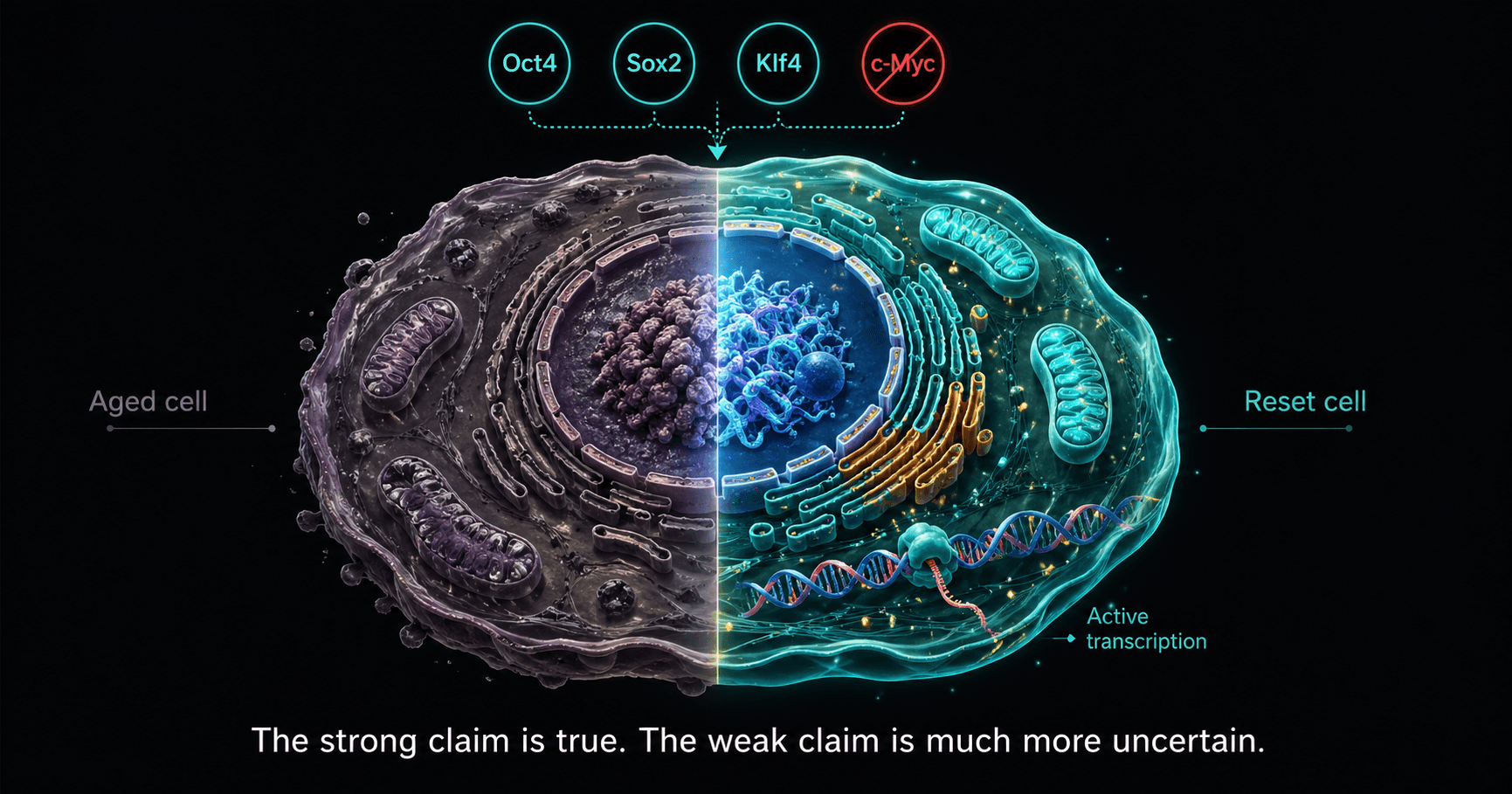
In 2006, Shinya Yamanaka demonstrated that four transcription factors — Oct4, Sox2, Klf4, and c-Myc, now called the Yamanaka factors — could take a fully differentiated adult somatic cell and reset it to a pluripotent state with a near-zero methylation age[2]. He won the Nobel Prize for it in 2012. The key thing this proved: somatic cells retain reprogrammability. The reset machinery isn't unique to oocytes. It's latent in cells we don't normally think of as having any plasticity at all.
Across the rest of biology, the existence proofs keep stacking. Heterochronic parabiosis experiments — surgically connecting the circulatory systems of young and old mice — show that young blood factors can partially rejuvenate aged tissues across multiple organ systems[3]. Planarian flatworms regenerate entire bodies from small fragments and show essentially no biological aging. Hydra exhibit negligible senescence. Turritopsis dohrnii, the so-called immortal jellyfish, can revert from its mature medusa form back to its juvenile polyp stage. Naked mole rats live 30+ years with cancer rates that look statistically broken compared to other rodents[4].
None of these prove that human age reversal is achievable next decade. What they collectively prove is something more important: every component of the rejuvenation problem — cellular age reset, somatic plasticity, tissue-level rejuvenation, organism-level age plasticity — has at least one demonstrated existence proof somewhere in biology. The aging-reversal problem doesn't require inventing new physics. It doesn't require violating any known biological law. It requires engineering capabilities that nature has already implemented in various forms.
This is the heart of why I take the field seriously. Aging reversal sits in the same scientific category as powered flight in 1900, organ transplantation in 1950, gene editing in 1990. Hard, unsolved, expensive, with many failed attempts ahead — but in the category of legitimate engineering targets, not in the category of perpetual motion machines.
What's actually happening in the clinic
The field has moved from theory to clinical reality faster than most outside observers realize.
In January 2026, the FDA cleared Life Biosciences' IND for ER-100 — a gene therapy delivering three Yamanaka factors (OCT4, SOX2, KLF4, dropping the cancer-associated c-Myc) via intravitreal injection[5]. It's the first cellular rejuvenation therapy using partial epigenetic reprogramming to enter human trials. The Phase 1 study targets two age-related optic nerve diseases: open-angle glaucoma and non-arteritic anterior ischemic optic neuropathy.
The path to this trial ran through some of the most carefully designed preclinical work in the field. In nonhuman primate studies, ER-100 was tested in a model of NAION created by laser-induced damage to the optic nerve. The therapy improved pattern electroretinogram signals, preserved retinal nerve fiber layer thickness, and increased surviving optic nerve axons compared to vehicle controls. Effects were seen with both preventive and rescue dosing protocols. The preclinical package was strong enough to clear FDA IND review — a non-trivial bar for a first-in-class mechanism with novel safety considerations.
This is real progress. Five years ago, the longevity field's clinical pipeline was essentially a wishlist. Today there's a Phase 1 trial of partial reprogramming actually enrolling patients, with the first systematic evaluation of OSK delivery in humans now underway. Other companies — Altos Labs, NewLimit, Retro Biosciences — are running parallel programs at varying stages. The mouse-to-NHP-to-human translation is happening, in real time, with real regulatory oversight.
But here's where I want to be careful, because I don't want this post to slide from "this is real science" into "this is about to cure aging."
The Life Biosciences trial is the easiest possible test case for partial reprogramming, by design. The eye is immune-privileged — it doesn't mount full immune responses, which is why other gene therapies like Luxturna succeeded there first. Intravitreal injection puts the therapy in a small, isolated compartment with no systemic biodistribution to worry about. Retinal ganglion cells are post-mitotic, which dramatically lowers the cancer risk that comes with reprogramming factors in dividing tissues. And the indication is acute injury repair, not aging reversal — the trial is testing whether the therapy can preserve cells against an acute insult, not whether it can rejuvenate naturally aged tissue.
If ER-100 succeeds in Phase 1, what we'll have shown is that localized partial reprogramming with OSK can be delivered safely in immune-privileged, post-mitotic human tissue. That is genuinely meaningful and it's the right place to start. It is not the same thing as showing that rejuvenation is deliverable to aged liver, muscle, brain, or systemically. The eye result, even if perfect, leaves these questions completely open:
- Does it work outside immune-privileged tissue?
- Does it work in dividing cell populations without inducing tumors?
- Can OSK be delivered systemically with acceptable AAV biodistribution and immunogenicity?
- Does the rejuvenation effect persist or require chronic re-dosing?
- What happens when you reprogram cells that have somatic mutations — which all aged cells have?
- Does any of this actually extend healthspan in humans, or just preserve specific tissues against specific insults?
None of these are answered by the current trial. They're the next ten to thirty years of work.
The pattern I want to flag
Here's something I've noticed in the discourse around longevity, and I think it matters more than the specific scientific debates: the field consistently elides two very different claims.
The first claim — call it the strong claim — is that systemic age reversal is physically and biologically possible. There is no thermodynamic, chemical, or fundamental biological barrier that prevents it. Nature has provided proof-of-concept at every level of the problem.
The second claim — the weak claim, though it's the one most loudly made — is that current efforts are on the right track and meaningful progress is imminent. That the specific mechanisms being pursued (partial reprogramming, senolytics, NAD+ precursors, blood factors) are likely to work, on commercially relevant timelines, with the funding currently deployed.
The strong claim is true. The weak claim is much more uncertain, and the evidence for it is weaker than the evidence for the strong claim.
The history of science is full of fields where the strong claim was correct (cancer is curable, the brain is computable, fusion is achievable) and the weak claim — about timelines and approaches — was wrong for decades.
For aging research, this distinction matters because the funding case, the regulatory case, and the personal-life-decisions case are all very different depending on which claim you're acting on. "Aging reversal is achievable as a long-term scientific endeavor" justifies the field existing, justifies serious research investment, and justifies treating it as a legitimate scientific frontier. It does not justify particular bets that any specific approach in 2026 will produce dramatic clinical effects in 2035.
Why the existence-proof argument still does real work
Even with all the caveats, the existence-proof argument changes how you should weigh the field. Here's why.
In drug discovery, one of the most important questions about any new mechanism is: does the underlying biology actually support the intervention? A huge fraction of clinical failures come from mechanisms that looked good on paper but weren't actually how the disease worked. The biology turned out to be wrong.
For aging reversal, the underlying biology is not speculative. The basic mechanism — that cells can be reset to a younger epigenetic state through transcription factor expression — is one of the most robustly demonstrated phenomena in modern molecular biology. Yamanaka reprogramming is taught in undergraduate cell biology courses. The methylation clocks that measure the reset are validated across dozens of independent studies[1]. We can argue about delivery, dosing, safety, durability, and translation. We can't really argue about whether the core biology is real.
Compare this to, say, Alzheimer's drug development, where the field spent thirty years and tens of billions of dollars on the amyloid hypothesis and is now seriously revisiting whether the underlying mechanism was even correct. Or to cancer immunotherapy before checkpoint inhibitors worked, where the basic premise — that the immune system could be unleashed against tumors — was correct but every specific approach failed for decades. In aging reversal, the mechanism question has the strongest possible answer: nature already does this.
What that means practically: the field is much more likely to be working on tractable problems (delivery, safety, tissue specificity, translation) than on intractable ones (whether the basic mechanism exists at all). Tractable problems get solved. The question becomes when, by whom, and at what cost — not whether.
What would change my mind
Any honest argument about a scientific field should specify what evidence would update the position. Here's mine.
I would update against the rejuvenation thesis if:
The first generation of partial reprogramming trials showed unexpected mechanism-related toxicity. Not safety signals at the margin (those are expected in early trials) but mechanism-related toxicity suggesting that controlled OSK expression in human tissue produces effects that don't track the mouse and primate data.
NHP studies in aged animals failed to show rejuvenation signals over multi-year timeframes. The mouse data on aging reversal[6] needs to be replicated in primates with naturally aged tissue, not just laser-injured young tissue. If that replication consistently fails, the species-translation gap is bigger than current models predict.
Methylation clock reset turned out not to correlate with functional rejuvenation. This is the deepest version of the concern: maybe the molecular markers we're using to measure age reversal are measuring the wrong thing, and resetting them doesn't restore function. Some critics of the epigenetic theory of aging argue exactly this[7]. If the clinical readouts in Phase 1 trials show methylation reset without functional improvement, that's a serious problem.
So far, none of these have happened. The data is moving in the direction the strong claim predicts. That doesn't make the weak claim true, but it keeps the strong claim well-supported.
Where this leaves a working professional
I'm writing this from the position of someone whose day job is figuring out which biology to bet a company on. So let me be specific about how I think about this practically, because I suspect this is the part most useful for other professionals reading.
Aging reversal as a scientific frontier is real and worth taking seriously. If you're a scientist, this is a legitimate field to work in. If you're an investor with very long time horizons, the platform plays — companies building reprogramming infrastructure, delivery technologies, methylation diagnostics — are defensible bets even if specific therapeutic programs fail.
Aging reversal as an imminent commercial reality is something to be much more skeptical about. Most companies in the space will fail. Most specific mechanisms being tried right now will not be the ones that work. The base rate for first-in-class biology in any therapeutic area is humbling. Phase 1 trials succeed roughly 60% of the time on safety, and Phase 1 to approval runs around 10% across all indications, lower for novel mechanisms[8]. Apply normal pharma base rates, not longevity-influencer base rates.
Aging reversal as a personal life-extension strategy — the supplements, the protocols, the biohacking — is mostly noise. The interventions with actual evidence (don't smoke, exercise, sleep, manage cardiovascular risk) have been the same for fifty years. Nothing in the cellular reprogramming field is currently translatable to over-the-counter intervention, and the people selling you NMN and rapamycin protocols are running ahead of the data by a margin that should embarrass them.
These three positions are consistent with each other, even though they sound contradictory if you're used to longevity discourse being all-or-nothing. The science is real. The commercial timelines are slower than advertised. The personal optimization grift is grift. Hold all three at once.
Coda
The argument I keep coming back to, when pharma colleagues ask me why I take this field seriously, isn't a specific paper or a specific result. It's the existence-proof argument.
Every generation, billions of times, biology takes an aged cell and resets its age to zero. The mechanism is implemented, in nature, at scale, with high reliability. Whatever the right intervention turns out to be — and we may not have found it yet — we're not asking nature to do something it has never done before. We're asking it to do something it does constantly, in a context where it normally doesn't.
That's a hard engineering problem. It is not an impossible one. The distinction matters, both for how we fund the science and for how we talk about it honestly. The field deserves better than either uncritical hype or reflexive dismissal. It deserves serious engagement with what the evidence actually shows — which is that one of the deepest assumptions in human biology, that aging is a one-way arrow, is wrong.
That's a real scientific update. The rest is engineering, and engineering is hard but it is not magic.
If you work in pharma, biotech, or AI and want to discuss any of this — including where you think I'm wrong — I'd genuinely like to hear it. The field needs more arguments and fewer pronouncements.
References
- 1.Horvath, S. (2013). DNA methylation age of human tissues and cell types. Genome Biology, 14(10), R115.
- 2.Takahashi, K. & Yamanaka, S. (2006). Induction of Pluripotent Stem Cells from Mouse Embryonic and Adult Fibroblast Cultures by Defined Factors. Cell, 126(4), 663–676.
- 3.Conboy, I.M. et al. (2005). Rejuvenation of aged progenitor cells by exposure to a young systemic environment. Nature, 433, 760–764.
- 4.Ruby, J.G. et al. (2018). Naked mole-rat mortality rates defy Gompertzian laws by not increasing with age. eLife, 7, e31157.
- 5.Life Biosciences (January 2026). Life Biosciences Receives FDA Clearance of IND for ER-100 — the first partial epigenetic reprogramming therapy to enter human clinical trials.
- 6.Lu, Y. et al. (2020). Reprogramming to recover youthful epigenetic information and restore vision. Nature, 588, 124–129.
- 7.Gladyshev, V.N. et al. (2024). Epigenetic clocks and aging: causes, correlates, and consequences. Nature Aging, 4, 896–911.
- 8.Wong, C.H. et al. (2019). Estimation of clinical trial success rates and related parameters. Biostatistics, 20(2), 273–286.